Deriving the Bessel Function of the First Kind for Zeroth Order

NOTE: I verified the solution using the following text: Boyce, W. and DiPrima, R. Elementary Differential Equations. 

In this post, I shall be deriving the Bessel function of the first kind for the zeroth order Bessel differential equation. Bessel’s equation is encountered when solving differential equations in cylindrical coordinates and is of the form

\displaystyle x^{2}\frac{d^{2}y}{dx^{2}}+x\frac{dy}{dx}+(x^{2}-\nu^{2})y(x)=0, (1)

where \nu = 0 describes the order zero of Bessel’s equation. I shall be making use of the assumption

\displaystyle y(x)=\sum_{j=0}^{\infty}a_{j}x^{j+r}, (2)

where upon taking the first and second order derivatives gives us

\displaystyle \frac{dy}{dx}=\sum_{j=0}^{\infty}(j+r)a_{j}x^{j+r-1}, (3)

and

\displaystyle \frac{d^{2}y}{dx^{2}}=\sum_{j=0}^{\infty}(j+r)(j+r-1)a_{j}x^{j+r-2}. (4)

Substitution into Eq.(1) and noting the order of the equation we arrive at

\displaystyle x^{2}\sum_{j=0}^{\infty}(j+r)(j+r-1)a_{j}x^{j+r-2}+x\sum_{j=0}^{\infty}(j+r)a_{j}x^{j+r-1}+x^{2}\sum_{j=0}^{\infty}a_{j}x^{j+r}=0. (5)

Distribution and simplification of Eq.(5) yields

\displaystyle \sum_{j=0}^{\infty}\bigg\{(j+r)(j+r-1)+(j+r)\bigg\}a_{j}x^{j+r}+\sum_{j=0}^{\infty}a_{j}x^{j+r+2}=0. (6)

If we evaluate the terms in which j=0 and j=1, we get the following

\displaystyle a_{0}\bigg\{r(r-1)+r\bigg\}x^{r}+a_{1}\bigg\{(1+r)r+(1+r)\bigg\}x^{r+1}+\sum_{j=2}^{\infty}\bigg\{[(j+r)(j+r-1)+(j+r)]a_{j}+a_{j-2}\bigg\}x^{j+r}=0, (7)

where I have introduced the dummy variable m=(j+r)-2 and I have shifted the indices downward by 2. Consider now the indicial equation (coefficients of a_{0}x^{r}),

\displaystyle r(r-1)+r=0, (8)

which upon solving gives r=r_{1}=r_{2}=0. We may determine the recurrence relation from summation terms from which we get

\displaystyle a_{j}(r)=\frac{-a_{j-2}(r)}{[(j+r)(j+r-1)+(j+r)]}=\frac{-a_{j-2}(r)}{(j+r)^{2}}. (9)

To determine J_{0}(x) we let r=0 in which case the recurrence relation becomes

\displaystyle a_{j}=\frac{-a_{j-2}}{j^{2}}, (10)

where j=2,4,6,.... Thus we have

\displaystyle J_{0}(x)=a_{0}x^{0}+a_{1}x+...  (11)

The only way the second term above is 0 is if a_{1}=0. So, the successive terms are a_{3},a_{5},a_{7},..., = 0. Let j=2k, where k\in \mathbb{Z}^{+}, then the recurrence relation is again modified to

\displaystyle a_{2k}=\frac{-a_{2k-2}}{(2k)^{2}}. (12)

 In general, for any value of k, one finds the expression

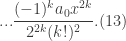
\displaystyle ... \frac{(-1)^{k}a_{0}x^{2k}}{2^{2k}(k!)^{2}}. (13)

Thus our solution for the Bessel function of the first kind is

\displaystyle J_{0}(x)=a_{0}\bigg\{1+\sum_{k=1}^{\infty}\frac{(-1)^{k}x^{2k}}{2^{2k}(k!)^{2}}\bigg\}. (14)

Basics of Tensor Calculus and General Relativity-Vectors and Introduction to Tensors (Part II-Continuation of Vectors)

SOURCE FOR CONTENT: Neuenschwander, D.E., 2015. Tensor Calculus for Physics. Johns Hopkins University Press. Ch.1

In the preceding post of this series, we saw how we may define a vector in the traditional sense. There is another formulation which is the focus of this post. One becomes familiar with this formulation typically in a second course in quantum mechanics or of a similar form in an introductory linear algebra course.

A vector may be written in two forms: a ket vector,

\displaystyle |A\rangle=\begin{pmatrix} a_{1}&\\ a_{2}&\\ \vdots &\\ a_{N} \end{pmatrix}, (1.1)

or a bra vector (conjugate vector):

\displaystyle \langle A|=\begin{pmatrix} a_{1} & a_{2} & \hdots & a_{N} \end{pmatrix}, (1.2)

Additionally, if \langle A| \in \mathbb{C}, then the conjugate vector takes the form

\displaystyle \langle A|=\begin{pmatrix} a_{1}^{*} & a_{2}^{*} & \hdots & a_{N}^{*} \end{pmatrix}. (1.3)

In words, if the conjugate vector exists in the complex plane, we may express such a vector in terms of complex conjugates of the components.

We may form the inner product by the following

\displaystyle \langle A|B\rangle = a_{1}^{*}b_{1}+a_{2}^{*}b_{2}+\hdots+a_{N}^{*}b_{M}=\sum_{i=1}^{N}\sum_{j=1}^{M}a_{i}^{*}b_{j}. (2)

Conversely we may form the outer product as follows

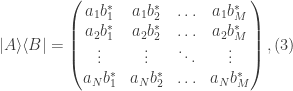
\displaystyle |A\rangle \langle B|= \begin{pmatrix} a_{1}b_{1}^{*} & a_{1}b_{2}^{*} & \hdots & a_{1}b_{M}^{*}\\ a_{2}b_{1}^{*} & a_{2}b_{2}^{*} & \hdots & a_{2}b_{M}^{*}\\ \vdots & \vdots & \ddots & \vdots \\ a_{N}b_{1}^{*} & a_{N}b_{2}^{*}& \hdots & a_{N}b_{M}^{*}\\ \end{pmatrix}, (3)

Additionally, one typically defines a vector as a linear combination of basis vectors which we shall express by the following:

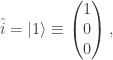
\displaystyle \hat{i}=|1\rangle \equiv \begin{pmatrix} 1 \\ 0 \\ 0 \\ \end{pmatrix},

\displaystyle \hat{j} = |2\rangle \equiv \begin{pmatrix} 0 \\ 1 \\ 0 \\ \end{pmatrix},

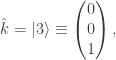
\displaystyle \hat{k}=|3\rangle \equiv \begin{pmatrix} 0 \\ 0 \\ 1 \\ \end{pmatrix},

where in general the basis vectors satisfy \langle i|j \rangle = \delta_{ij}. Therefore we can write any arbitrary vector in the following way

\displaystyle \textbf{A}= a_{1}|1\rangle + a_{2}|2\rangle + ... + a_{n}|n\rangle. (4)

Moreover, any conjugate vector may be written as

\displaystyle \langle B|= b_{1}\langle 1| + b_{2}\langle 2| + ... + b_{m}\langle m|. (5)

Let \mathcal{P} = |A\rangle \langle B| represent the outer product which may also be written in component form as \mathcal{P}_{ij}=\langle i|\mathcal{P}|j\rangle. We therefore have the condition that

\displaystyle \textbf{1} = \sum_{\mu}|\mu\rangle \langle \mu|,  (6)

and

\displaystyle |A\rangle = \sum_{\mu}|\mu\rangle \langle \mu|A\rangle =\sum_{\mu}A^{\mu}|\mu\rangle, (7)

wherein \displaystyle A^{\mu}\equiv \langle \mu|A\rangle. The first relation represents the completeness of an orthonormal set of basis vectors and the second is its modified form.

The next post will discuss the transformations of coordinates of vectors using both the matrix formulation and using partial derivatives.


Consequences and some Elementary Theorems of the Ideal One-Fluid Magnetohydrodynamic Equations

SOURCE FOR CONTENT:

Priest, E. Magnetohydrodynamics of the Sun, 2014. Cambridge University Press. Ch.2.;

Davidson, P.A., 2001. An Introduction to Magnetohydrodynamics. Ch.4. 

We have seen how to derive the induction equation from Maxwell’s equations assuming no charge and assuming that the plasma velocity is non-relativistic. Thus, we have the induction equation as being

\displaystyle \frac{\partial \textbf{B}}{\partial t}=\nabla \times (\textbf{v}\times \textbf{B})+\lambda \nabla^{2}\textbf{B}. (1)

Many texts in MHD make the comparison of the induction equation to the vorticity equation

\displaystyle \frac{\partial \Omega}{\partial t}= \nabla \times (\textbf{v} \times \Omega)+\nu \nabla^{2}\Omega, (2)

where I have made use of the vector identity

\nabla \times (\textbf{X}\times \textbf{Y})=\textbf{X}(\nabla \cdot \textbf{Y})-\textbf{Y}(\nabla \cdot \textbf{X})+(\textbf{Y}\cdot \nabla)\textbf{X}-(\textbf{X}\cdot \nabla)\textbf{Y}.

Indeed, if we do compare the induction equation (Eq.(1)) to the vorticity equation (Eq.(2)) we easily see the resemblance between the two. The first term on the right hand side of Eq.(1)/ Eq.(2) determines the advection of magnetic field lines/vortex field lines; the second term on the right hand side deals with the diffusion of the magnetic field lines/vortex field lines.

From this, we can impose restrictions and thus look at the consequences of the induction equation (since it governs the evolution of the magnetic field). Furthermore, we see that we can modify the kinematic theorems of classical vortex dynamics to describe the properties of magnetic field lines. After discussing the direct consequences of the induction equation, I will discuss a few theorems of vortex dynamics and then introduce their MHD analogue.

Inherent to this is magnetic Reynold’s number. In geophysical fluid dynamics, the Reynolds number (not the magnetic Reynolds number) is a ratio between the viscous forces per volume and the inertial forces per volume given by

\displaystyle Re=\frac{ul}{V}, (3)

where u, l, V represent the typical fluid velocity, length scale and typical volume respectively. The magnetic Reynolds number is the ratio between the advective and diffusive terms of the induction equation. There are two canoncial regimes: (1) Re_{m}<<1, and (2)Re_{m}>>1 The former is sometimes called the diffusive limit and the latter is called either the Ideal limit or the infinite conductivity limit (I prefer to call it the ideal limit, since the terms infinite conductivity limit is not quite accurate).


Case I:  Re_{m}<<1

Consider again the induction equation

\displaystyle \frac{\partial \textbf{B}}{\partial t}=\nabla \times (\textbf{v}\times \textbf{B})+\lambda\nabla^{2}\textbf{B}.

If we then assume that we are dealing with incompressible flows (i.e. (\nabla \cdot \textbf{v})=0) then we can use the aforementioned vector identity to write the induction equation as

\displaystyle \frac{D\textbf{B}}{Dt}=(\textbf{B}\cdot \nabla)\textbf{v}+\lambda\nabla^{2}\textbf{B}. (4)

In the regime for which Re_{m}<<1, the induction equation for incompressible flows (Eq.(4)) assumes the form
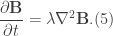
\displaystyle \frac{\partial \textbf{B}}{\partial t}=\lambda \nabla^{2}\textbf{B}. (5)

Compare this now to the following equation,
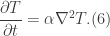
\displaystyle \frac{\partial T}{\partial t}=\alpha \nabla^{2}T. (6)

We see that the magnetic field lines are diffused through the plasma.


Case II: Re_{m}>>1

If we now consider the case for which the advective term dominates, we see that the induction equation takes the form

\displaystyle \frac{\partial \textbf{B}}{\partial t}=\nabla \times (\textbf{v}\times \textbf{B}). (7)

Mathematically, what this suggests is that the magnetic field lines become “frozen-in” the plasma, giving rise to Alfven’s theorem of flux freezing.

Many astrophysical systems require a high magnetic Reynolds number. Such systems include the solar magnetic field (heliospheric current sheet), planetary dynamos (Earth, Jupiter, and Saturn), and galactic magnetic fields.

Kelvin’s Theorem & Helmholtz’s Theorem:

Kelvin’s Theorem: Consider a vortex tube in which we have that (\nabla \cdot \Omega)=0, in which case

\displaystyle \oint \Omega \cdot d\textbf{S}=0, (8)

and consider also the curve taken around a closed surface, (we call this curve a material curve C_{m}(t)) we may define the circulation as being
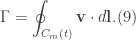
\displaystyle \Gamma = \oint_{C_{m}(t)}\textbf{v}\cdot d\textbf{l}. (9)

Thus, Kelvin’s theorem states that if the material curve is closed and it consists of identical fluid particles then the circulation, given by Eq.(9), is temporally invariant.

Helmholtz’s Theorem:

Part I: Suppose we consider a fluid element which lies on a vortex line at some initial time t=t_{0}, according to this theorem it states that this fluid element will continue to lie on that vortex line indefinitely.

Part II: This part says that the flux of vorticity

\displaystyle \Phi = \int \Omega \cdot d\textbf{S}, (10)

remains constant for each cross-sectional area and is also invariant with respect to time.


Now the magnetic analogue of Helmholtz’s Theorems are found to be Alfven’s theorem of flux freezing and conservation of magnetic flux, magnetic field lines, and magnetic topology.

The first says that fluid elements which lie along magnetic field lines will continue to do so indefinitely; basically the same for the first Helmholtz theorem.

The second requires a more detailed argument to demonstrate why it works but it says that the magnetic flux through the plasma remains constant. The third says that magnetic field lines, hence the magnetic structure may be stretched and deformed in many ways, but the magnetic topology overall remains the same.

The justification for these last two require some proof-like arguments and I will leave that to another post.

In my project, I considered the case of high magnetic Reynolds number in order to examine the MHD processes present in region of metallic hydrogen present in Jupiter’s interior.

In the next post, I will “prove” the theorems I mention and discuss the project.
Basic Equations of Ideal One-Fluid Magnetohydrodynamics: (Part V) The Energy Equations and Summary

SOURCE FOR CONTENT: Priest E., Magnetohydrodynamics of the Sun, 2014. Ch. 2. Cambridge University Press.


The final subset of equations deals with the energy equations. My undergraduate research did not take into account the thermodynamics of conducting fluid in order to keep the math relatively simple. However, in order to understand MHD one must take into account these considerations. Therefore, there are three essential equations that are indicative of the energy equations:

I. Heat Equation:

We may write this equation in terms of the entropy S as

\displaystyle \rho T \bigg\{\frac{\partial S}{\partial t}+(\nabla \cdot \textbf{v})S\bigg\}=-\mathcal{L}, (1)

where \mathcal{L} represents the net effect of energy sinks and sources and is called the energy loss function. For simplicity, one typically writes the form of the heat equation to be
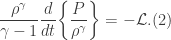

\displaystyle \frac{\rho^{\gamma}}{\gamma -1}\frac{d}{dt}\bigg\{\frac{P}{\rho^{\gamma}}\bigg\}=-\mathcal{L}. (2)

2. Conduction

For this equation one considers the explicit form of the energy loss function as being

\displaystyle \mathcal{L}=\nabla \cdot \textbf{q}+L_{r}-\frac{J^{2}}{\sigma}-F_{H}, (3)

where \textbf{q} represents heat flux by particle conduction, L_{r} is the net radiation, J^{2}/\sigma is the Ohmic dissipation, and F_{H} represents external heating sources, if any exist.  The term \textbf{q} is given by

\textbf{q}=-\kappa \nabla T, (4)

where \kappa is the thermal conduction tensor.

3. Radiation

The equation for radiation can be written as a variation of the diffusion equation for temperature

\displaystyle \frac{DT}{Dt}=\kappa \nabla^{2}T (5)

where \kappa here denotes the thermal diffusivity given by

\displaystyle \kappa = \frac{\kappa_{r}}{\rho c_{P}}. (6)

We may write the final form of the energy equation as

\displaystyle \frac{\rho^{\gamma}}{\gamma-1}\frac{d}{dt}\bigg\{\frac{P}{\rho^{\gamma}}\bigg\}=-\nabla \cdot \textbf{q}-L_{r}+J^{2}/\sigma+F_{H}, (7)

where \textbf{q} is given by Eq.(4).

As far as my undergraduate research is concerned, I am including these equations to be complete.


So to summarize the series so far, I have derived most of the basic equations of ideal one-fluid model of magnetohydrodynamics. The equations are

\displaystyle \frac{\partial \textbf{B}}{\partial t}=(\textbf{v}\times \textbf{B})+\lambda \nabla^{2}\textbf{B}, (A)

\displaystyle \frac{\partial \textbf{v}}{\partial t}+(\nabla \cdot \textbf{v})\textbf{v}=-\frac{1}{\rho}\nabla\bigg\{P+\frac{B^{2}}{2\mu_{0}}\bigg\}+\frac{(\nabla \cdot \textbf{B})\textbf{B}}{\mu_{0}\rho}, (B)

\displaystyle \frac{\partial \rho}{\partial t}+(\nabla \cdot \rho\textbf{v})=0, (C)

\displaystyle \frac{\partial \Omega}{\partial t}+(\nabla \cdot \textbf{v})\Omega = (\nabla \cdot \Omega)\textbf{v}+\nu \nabla^{2}\Omega, (D)

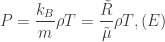
\displaystyle P = \frac{k_{B}}{m}\rho T = \frac{\tilde{R}}{\tilde{\mu}}\rho T, (E) (Ideal Gas Law)

and

\displaystyle \frac{\rho^{\gamma}}{\gamma-1}\frac{d}{dt}\bigg\{\frac{P}{\rho^{\gamma}}\bigg\}=-\nabla \cdot \textbf{q}-L_{r}+J^{2}/\sigma +F_{H}.  (F)

We also have the following ancillary equations

\displaystyle (\nabla \cdot \textbf{B})=0, (G.1)

since we haven’t found evidence of the existence of magnetic monopoles. We also have that

\displaystyle \nabla \times \textbf{B}=\mu_{0}\textbf{J}, (G.2)

where we are assuming that the plasma velocity v << c (i.e. non-relativistic). Finally for incompressible flows we know that (\nabla \cdot \textbf{v})=0 corresponding to isopycnal flows.
 

In the next post, I will discuss some of the consequences of these equations and some elementary theorems involving conservation of magnetic flux and magnetic field line topology.

Solution to the Hermite Differential Equation

One typically finds the Hermite differential equation in the context of an infinite square well potential and the consequential solution of the Schrödinger equation. However, I will consider this equation is its “raw” mathematical form viz.

\displaystyle \frac{d^{2}y}{dx^{2}}-2x\frac{dy}{dx}+\lambda y(x) =0. (1)

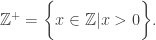
First we will consider the more general case, leaving \lambda undefined. The second case will consider in a future post \lambda = 2n, n\in \mathbb{Z}^{+}, where \mathbb{Z}^{+}=\bigg\{x\in\mathbb{Z}|x > 0\bigg\}.

PART I: 

Let us assume the solution has the form

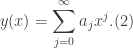
\displaystyle y(x)=\sum_{j=0}^{\infty}a_{j}x^{j}. (2)

Now we take the necessary derivatives

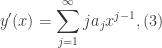
\displaystyle y^{\prime}(x)=\sum_{j=1}^{\infty}ja_{j}x^{j-1}, (3)

\displaystyle y^{\prime \prime}(x)=\sum_{j=2}^{\infty} j(j-1)a_{j}x^{j-2}, (4)

where upon substitution yields the following

\displaystyle \sum_{j=2}^{\infty}j(j-1)a_{j}x^{j-2}-\sum_{j=1}^{\infty}2ja_{j}x^{j}+\sum_{j=0}^{\infty}\lambda a_{j}x^{j}=0, (5)

Introducing the dummy variable m=j-2 and using this and its variants we arrive at

\displaystyle \sum_{j=0}^{\infty}(j+2)(j+1)a_{j+2}x^{j}-\sum_{j=0}^{\infty}2ja_{j}x^{j}+\sum_{j=0}^{\infty}\lambda a_{j}x^{j}=0. (6)

Bringing this under one summation sign…

\displaystyle \sum_{j=0}^{\infty}[(j+2)(j+1)a_{j+2}-2ja_{j}+\lambda a_{j}]x^{j}=0. (7)

Since \displaystyle \sum_{j=0}^{\infty}x^{j}\neq 0, we therefore require that

\displaystyle (j+2)(j+1)a_{j+2}=(2j - \lambda)a_{j}, (8)

or

\displaystyle a_{j+2}=\frac{(2j-\lambda)a_{j}}{(j+2)(j+1)}. (9)

This is our recurrence relation. If we let j=0,1,2,3,... we arrive at two linearly independent solutions (one even and one odd) in terms of the fundamental coefficients a_{0} and a_{1} which may be written as

\displaystyle y_{even}(x)= a_{0}\bigg\{1+\sum_{j=0}^{j/2}\frac{(-1)^{j}(\lambda -2j)!}{(j+2)!}x^{j}\bigg\}, (10)

and

\displaystyle y_{odd}(x)=a_{1}\bigg\{\sum_{j=0}^{(j-1)/2}\frac{(-1)^{j}(\lambda-2j)!}{(j+2)!}x^{j}\bigg\}. (11)

Thus, our final solution is the following

\displaystyle y(x)=y_{even}(x)+y_{odd}(x), (12.1)


\displaystyle y(x)=a_{0}\bigg\{1+\sum_{j=0}^{j/2}\frac{(-1)^{j}(\lambda-2j)!}{(j+2)!}x^{j+2}\bigg\}+a_{1}\bigg\{x+\sum_{j=1}^{(j-1)/2}\frac{(-1)^{j}(\lambda-2j)!}{(j+2)!}x^{j+2}\bigg\}. (12.2)


Legendre Polynomials

Some time ago, I wrote a post discussing the solution to Legendre’s ODE. In that post, I discussed what is an alternative definition of Legendre polynomials in which I stated Rodriguez’s formula:

\displaystyle \frac{1}{2^{p}p!}\frac{d^{p}}{dx^{p}}\bigg\{(x^{2}-1)^{p}\bigg\}, (0.1)

where

\displaystyle P_{p}(x)=\sum_{n=0}^{\alpha}\frac{(-1)^{n}(2p-2n)!}{2^{p}{n!}(p-n)!(p-2n)!} (0.2),

and

\displaystyle P_{p}(x)=\sum_{n=0}^{\beta}\frac{(-1)^{n}(2p-2n)!}{2^{p}{n!}(p-n)!(p-2n)!} (0.3)

in which I have let \displaystyle \alpha=p/2 and \displaystyle \beta=(p-1)/2 corresponding to the even and odd expressions for the Legendre polynomials.

However, in this post I shall be using the approach of the generating function. This will be from a purely mathematical perspective, so I am not applying this to any particular topic of physics.

Consider a triangle with sides \displaystyle X,Y.Z and angles \displaystyle \theta, \phi, \lambda. The law of cosines therefore maintains that

\displaystyle Z^{2}=X^{2}+Y^{2}-2XY\cos{(\lambda)}. (1)

We can factor out \displaystyle X^{2} from the left hand side of Eq.(1), take the square root and invert this yielding

\displaystyle \frac{1}{Z}=\frac{1}{X}\bigg\{1+\bigg\{\frac{Y}{X}\bigg\}^{2}-2\bigg\{\frac{Y}{X}\bigg\}\cos{(\lambda)}\bigg\}^{-1/2}. (2)

Now, we can expand this by means of the binomial expansion. Let \displaystyle \kappa \equiv \bigg\{\frac{Y}{X}\bigg\}^{2}-2\bigg\{\frac{Y}{X}\bigg\}\cos{(\lambda)}, therefore the binomial expansion is

\displaystyle \frac{1}{(1+\kappa)^{1/2}}=1-\frac{1}{2}\kappa+\frac{3}{8}\kappa^{2}-\frac{5}{16}\kappa^{3}+... (3)

Hence if we expand this in terms of the sides and angle(s) of the triangle and group by powers of \displaystyle (y/x) we get

\displaystyle \frac{1}{Z}=\frac{1}{X}\bigg\{1+\bigg\{\frac{Y}{X}\bigg\}\cos{(\lambda)}+\bigg\{\frac{Y}{X}\bigg\}^{2}\frac{1}{2}(3\cos^{2}{(\lambda)}-1)+\bigg\{\frac{Y}{X}\bigg\}^{3}\frac{1}{2}(5\cos^{3}{(\lambda)}-3\cos{(\lambda)}\bigg\}.(4)

Notice the coefficients, these are precisely the expressions for the Legendre polynomials. Therefore, we see that

\displaystyle \frac{1}{Z}=\frac{1}{X}\bigg\{\sum_{l=0}^{\infty}\bigg\{\frac{Y}{X}\bigg\}^{l}P_{l}(\cos{(\lambda)}\bigg\}, (5)

or

\displaystyle \frac{1}{Z}=\frac{1}{\sqrt[]{X^{2}+Y^{2}-2XY\cos{(\lambda)}}}=\sum_{l=0}^{\infty}\frac{Y^{l}}{X^{l+1}}P_{l}(\cos{(\lambda)}. (6)

Thus we see that the generating function \displaystyle 1/Z generates the Legendre polynomials. Two prominent uses of these polynomials includes gravity and its application to the theory of potentials of a spherical mass distributions, and the other is that of electrostatics. For example, suppose we have the potential equation

\displaystyle V(r)=\frac{1}{4\pi\epsilon_{0}}\int_{V}\rho(R)\frac{\hat{\mathcal{R}}}{\mathcal{R_{0}}}d\tau. (7.1)

We may use the result of the generating function to get the following result for the electric potential due an arbitrary charge distribution

\displaystyle V(\mathcal{R})=\frac{1}{4\pi\epsilon_{0}}\sum_{l=0}^{\infty}\frac{\mathcal{R}^{l}}{\mathcal{R_{0}}^{l+1}}\int P_{l}(\cos{(\lambda)}). (7.2)

(For more details, see Chapter 3 of Griffith’s text: Introduction to Electrodynamics.)


Basics of Tensor Calculus and General Relativity-Vectors and Introduction to Tensors (Part I: Vectors)

SOURCE FOR CONTENT: Neuenschwander D.E.,2015. Tensor Calculus for Physics. Johns Hopkins University Press. 

At some level, we all are aware of scalars and vectors, but typically we don’t think of aspects of everyday experience as being a scalar or a vector. A scalar is something that has only magnitude, that is it only has a numeric value. A typical example of a scalar would be temperature. A vector, on the other hand, is something that has both a magnitude and direction. This could be something as simple as displacement. If we wish to move a certain distance with respect to our current location we must specify how far to go and in which direction to move. Other examples, (and there are a lot of them), including velocity, force, momentum, etc. Now, tensors are something else entirely. In Neuenschwander’s “Tensor Calculus for Physics”, he recites the rather unsatisfying definition of a tensor as being

” ‘A set of quantities T_{s}^{r} associated with a point P are said to be components of a second-order tensor if, under a change of coordinates, from a set of coordinates x^{s} to x^{\prime s}, they transform according to

\displaystyle T^{\prime r}_{s}=\frac{\partial x^{\prime r}}{\partial x^{i}}\frac{\partial x^{j}}{\partial x^{\prime s}}T_{j}^{i}. (1)

where the derivatives are evaluated at the aforementioned point.’ “

Neuenschwander describes his frustration when encountered this so-called definition of a tensor. Like him, I found I had similar frustrations, and as a result, I had even more questions.

We shall start with a discussion of vectors, for an understanding of these quantities are an integral part of tensor analysis.

We define a vector as a quantity that has 3 distinct components and an angle that indicates orientation or direction. There are two types of vectors; those with coordinates and those without. I will be discussing the latter first, but I will consider Neuenschwander’s description in the context of the definition of a vector space. Then I shall move on to the former. Consider a number of arbitrary vectors \displaystyle \textbf{U}, \textbf{V}, \textbf{W},etc. If we consider further more and more vectors, we can therefore imagine a space constituted by these vectors; a vector space. To make it formal, here is the definition:

Def. Vector Space:

A vector space \mathcal{S} is the nonempty set of elements (vectors) that satisfy the following axioms

\displaystyle 1.\textbf{U}+\textbf{V}=\textbf{V}+\textbf{U};  \forall \textbf{U},\textbf{V}\in \mathcal{S},

\displaystyle 2. (\textbf{U}+\textbf{V})+\textbf{W}= \textbf{U}+(\textbf{V}+\textbf{W}); \forall \textbf{U},\textbf{V},\textbf{W}\in \mathcal{S},

\displaystyle 3. \exists  0 \in \mathcal{S}|\textbf{U}+0=\textbf{U},

\displaystyle 4. \forall \textbf{U}\in \mathcal{S}, \exists -\textbf{U}\in \mathcal{S}|\textbf{U}+(-\textbf{U})=0,

\displaystyle 5. \alpha(\textbf{U}+\textbf{V})=\alpha\textbf{U}+\alpha\textbf{V}, \forall \alpha \in \mathbb{R},  \forall \textbf{U},\textbf{V}\in \mathcal{S}.

\displaystyle 6. (\alpha+\beta) \textbf{U}= \alpha\textbf{U}+\beta\textbf{U}, \forall \alpha,\beta \in \mathbb{R},

\displaystyle 7. (\alpha\beta)\textbf{U}= \alpha(\beta\textbf{U}), \forall \alpha,\beta \in \mathbb{R},

\displaystyle 8. 1\textbf{U}=\textbf{U}, \forall \textbf{U}\in \mathcal{S},

and satisfies the following closure properties:

 1. If \textbf{U}\in \mathcal{S}, and \alpha is a scalar, then \alpha\textbf{U}\in \mathcal{S}.

2. If \textbf{U},\textbf{V}\in \mathcal{S}, then \textbf{U}+\textbf{V}\in \mathcal{S}.

The first closure property ensures closure under scalar multiplication while the second ensures closure under addition.

In rectangular coordinates, our arbitrary vector may be represented by basis vectors \hat{i}, \hat{j},\hat{k} in the following manner

\displaystyle \textbf{U}=u\hat{i}+v\hat{j}+w\hat{k}, (1)

where the basis vectors have the properties

\displaystyle \hat{i}\cdot \hat{i}=\hat{j}\cdot \hat{j}=\hat{k}\cdot \hat{k}=1, (2.1)

\displaystyle \hat{i}\cdot \hat{j}=\hat{j}\cdot \hat{k}=\hat{i}\cdot \hat{k}=0.(2.2)

The latter of which implies that these basis vectors are mutually orthogonal. We can therefore write these in a more succinct way via

\displaystyle \hat{e}_{i}\cdot \hat{e}_{j}=\delta_{ij},  (2.3)

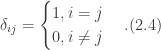
where \displaystyle \delta_{ij} denotes the Kronecker delta:

\displaystyle \delta_{ij}=\begin{cases} 1, i=j\\ 0, i \neq j \end{cases}. (2.4)

We may redefine the scalar product by the following argument given in Neuenschwander

\displaystyle \textbf{U}\cdot  \textbf{V}=\sum_{i,j=1}^{3}(U^{i} \hat{e}_{i}) \cdot (V^{j} \hat{e}_{j})=\sum_{i,j=1}^{3}U^{i}V^{j}(\delta_{ij})=\sum_{l=1}^{3}U^{l}V^{l}. (3)

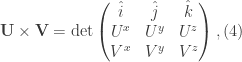
Similarly we may define the cross product to be

\displaystyle \textbf{U}\times \textbf{V}=\det\begin{pmatrix} \hat{i}  & \hat{j} & \hat{k} \\ U^{x} & U^{y} & U^{z} \\ V^{x} & V^{y} & V^{z}  \end{pmatrix}, (4)

whose i-th component is

\displaystyle (\textbf{U}\times \textbf{V})^{i}=\textbf{U}\times \textbf{V}=\sum_{i,j=1}^{3}\epsilon^{ijk}U^{j}V^{k}, (5)

where \epsilon^{ijk} denotes the Levi-Civita symbol. If these indices form an odd permutation \epsilon^{ijk}=-1, if the indices form an even permutation \epsilon^{ijk}=+1, and if any of these indices are equal \epsilon^{ijk}=0.

As a final point, we may relate vectors to relativity by means of defining the four-vector. If we consider the four coordinates x,y,z,t, they collectively describe what is referred to as an event. Formally, an event in spacetime is described by three spatial coordinates and one time coordinate. We may replace these coordinates by x^{\mu}, where \mu \in \mathbb{Z}^{\pm} in which I am defining \mathbb{Z}^{\pm}=\bigg\{x\in \mathbb{Z}|x\geq 0\bigg\}. In words, this means that the index \mu is an integer that is greater than or equal to 0.

Furthermore, the quantity x^{0} corresponds to time, x^{1,2,3} correspond to the x,y, and z coordinates respectively.  Therefore, x^{\mu}=(ct,x,y,z) is called the four-position.

In the next post, I will complete the discussion on vectors and discuss in more detail the definition of a tensor (following Neuenschwander’s approach). I will also introduce a few examples of tensors that physics students will typically encounter.


Monte Carlo Simulations of Radiative Transfer: Basics of Radiative Transfer Theory (Part IIa)

SOURCES FOR CONTENT:

  1. Chandrasekhar, S., 1960. “Radiative Transfer”. Dover. 1.
  2. Choudhuri, A.R., 2010. “Astrophysics for Physicists”. Cambridge University Press. 2.
  3. Boyce, W.E., and DiPrima, R.C., 2005. “Elementary Differential Equations”. John Wiley & Sons. 2.1.


Recall from last time , the radiative transfer equation

\displaystyle \frac{1}{\epsilon \rho}\frac{dI_{\nu}}{ds}= M_{\nu}-N_{\nu}I_{\nu}, (1)

where M_{\nu} and N_{\nu} are the emission and absorption coefficients, respectively. We can further define the absorption coefficient to be equivalent to \epsilon \rho. Hence,

\displaystyle N_{\nu}=\frac{d\tau_{\nu}}{ds}, (2)

which upon rearrangement and substitution in Eq. (1) gives

\displaystyle \frac{dI_{\nu}(\tau_{\nu})}{d\tau_{\nu}}+I_{\nu}(\tau_{\nu})= U_{\nu}(\tau_{\nu}). (3)

We may solve this equation by using the method of integrating factors, by which we multiply Eq.(3) by some unknown function (the integrating factor) \mu(\tau_{\nu}) yielding

\displaystyle \mu(\tau_{\nu})\frac{dI_{\nu}(\tau_{\nu})}{d\tau_{\nu}}+\mu(\tau_{\nu})I_{\nu}(\tau_{\nu})=\mu(\tau_{\nu})U_{\nu}(\tau_{\nu}). (4)

Upon examining Eq.(4), we see that the left hand side is the product rule. It follows that

\displaystyle \frac{d}{d\tau_{\nu}}\bigg\{\mu(\tau_{\nu})I_{\nu}(\tau_{\nu})\bigg\}=\mu({\tau_{\nu}})U_{\nu}(\tau_{\nu}). (5)

This only works if  d(\mu(\tau_{\nu}))/d\tau_{\nu}=\mu(\tau_{\nu}). To show that this is valid, consider the equation for \mu(\tau_{\nu}) only:

\displaystyle \frac{d\mu(\tau_{\nu})}{d\tau_{\nu}}=\mu(\tau_{\nu}). (6.1)

This is a separable ordinary differential equation so we can rearrange and integrate to get

\displaystyle \int \frac{d\mu(\tau_{\nu})}{\mu(\tau_{\nu})}=\int d\tau_{\nu}\implies \ln(\mu(\tau_{\nu}))= \tau_{\nu}+C, (6.2)

where C is some constant of integration. Let us assume that the constant of integration is 0, and let us also take the exponential of (6.2). This gives us

\displaystyle \mu(\tau_{\nu})=\exp{(\tau_{\nu})}. (6.3)

This is our integrating factor. Just as a check, let us take the derivative of our integrating factor with respect to d\tau_{\nu},

\displaystyle \frac{d}{d\tau_{\nu}}\exp{(\tau_{\nu})}=\exp{(\tau_{\nu})},

Thus this requirement is satisfied. If we now return to Eq.(4) and substitute in our integrating factor we get

\displaystyle \frac{d}{d\tau_{\nu}}\bigg\{\exp{(\tau_{\nu})}I_{\nu}(\tau_{\nu})\bigg\}=\exp{(\tau_{\nu})}U_{\nu}(\tau_{\nu}). (7)

We can treat this as a separable differential equation so we can integrate immediately. However, we are integrating from an optical depth 0 to some optical depth \tau_{\nu}, hence we have that

\displaystyle \int_{0}^{\tau_{\nu}}d\bigg\{\exp{(\tau_{\nu})}I_{\nu}(\tau_{\nu})\bigg\}=\int_{0}^{\tau_{\nu}}\bigg\{\exp{(\bar{\tau}_{\nu})}U_{\nu}(\bar{\tau}_{\nu})\bigg\}d\bar{\tau}_{\nu}, (8)

We find that

\displaystyle \exp{(\tau_{\nu})}I_{\nu}(\tau_{\nu})-I_{\nu}(0)=\int_{0}^{\tau_{\nu}}\bigg\{\exp{(\bar{\tau}_{\nu})}U_{\nu}(\bar{\tau}_{\nu})\bigg\}d\bar{\tau}_{\nu} (9),

where if we add I_{\nu}(0) and divide by \exp{(\tau_{\nu})} we arrive at the general solution of the radiative transfer equation

\displaystyle I_{\nu}(\tau_{\nu}) = I_{\nu}(0)\exp{(-\tau_{\nu})}+\int_{0}^{\tau_{\nu}}\exp{(\bar{\tau}_{\nu}-\tau_{\nu})}U_{\nu}(\bar{\tau}_{\nu})d\bar{\tau}_{\nu}. (10)

This is the mathematically formal solution to the radiative transfer equation. While mathematically sound, much of the more interesting physical phenomena require more complicated equations and therefore more sophisticated methods of solving them (an example would be the use of quadrature formulae or n-th approximation for isotropic scattering).

Recall also that in general we can write the phase function p(\theta,\phi; \theta^{\prime},\phi^{\prime}) via the following

\displaystyle p(\theta,\phi;\theta^{\prime},\phi^{\prime})=\sum_{l=0}^{\infty}\gamma_{l}P_{l}(\cos{\Theta}). (11)

Let us consider the case for which l=0 in the sum given by (11). This then would mean that the phase function is constant

p(\theta,\phi;\theta^{\prime},\phi^{\prime})=\gamma_{0}=const. (12)

Such a phase function is consistent with isotropic scattering. The term isotropic means, in this context, that radiation scattered is the same in all directions. Such a case yields a source function of the form

\displaystyle U_{\nu}(\tau_{\nu})=\frac{1}{4\pi}\int_{0}^{\pi}\int_{0}^{2\pi}\gamma_{0}I_{\nu}(\tau_{\nu})\sin{\theta^{\prime}}d\theta^{\prime}d\phi^{\prime}, (13)

where upon use in the radiative transfer equation we get the integro-differential equation

\displaystyle \frac{dI_{\nu}(\tau_{\nu})}{d\tau_{\nu}}+I_{\nu}(\tau_{\nu})= \frac{1}{4\pi}\int_{0}^{\pi}\int_{0}^{2\pi}\gamma_{0}I_{\nu}(\tau_{\nu})\sin{\theta^{\prime}}d\theta^{\prime}d\phi^{\prime}. (14)

Solution of this equation is beyond the scope of the project. In the next post I will discuss Rayleigh scattering and the corresponding phase function.


Basics of Tensor Calculus and General Relativity: Overview of Series

Of the many topics that I have studied in the past, one of the most confusing topics that I have encountered is the concept of a tensor. Every time that I heard the term tensor, it was mentioned for the sake of mentioning it and my professors would move on. Others simply ignored the existence of tensors, but every time they were brought up I was intrigued. So the purpose of this series is to attempt to discover how tensors work and how they relate to our understanding of the universe, specifically in the context of general relativity.

The text I will be following for this will be Dwight E. Neuenschwander’s “Tensor Calculus for Physics”.  I will be documenting my interpretation of the theory discussed in this text, and I will use the text “General Relativity: An Introduction for Physicists” by M.P. Hobson, G. Efstathiou, and A.N. Lasenby to discuss the concepts developed in the context of general relativity. I will list the corresponding chapter titles associated with each post.

Here is an approximate agenda (note that this will take some time as I am learning this as I post, so posts in this series may be irregular).

Post I: Tensor Calculus: Introduction and Vectors

Post II: Tensor Calculus: Vector Calculus and Coordinate Transformations

Post III: General Relativity: Basics of Manifolds and Coordinates

Post IV: General Relativity: Vector Calculus on Manifolds

Post V: Tensor Calculus: Introduction to Tensors and the Metric Tensor

Post VI: Tensor Calculus: Derivatives of Tensors

Post VII: General Relativity: Tensor Calculus on Manifolds

Post VIII: Tensor Calculus: Curvature

Post IX: General Relativity: Equivalence Principle and Spacetime Curvature

Post X: General Relativity: The Gravitational Field Equations

The series will end with the Einstein field equations (EFEs) since they are the crux of the general theory of relativity. The posts in this series will come in their own time as they can be quite difficult and time-consuming, but I will do my best to understand it. I welcome any feedback you may have, but please be respectful.


Simple Harmonic Oscillators (SHOs) (Part I)

We all experience or see this happening in our everyday experience: objects moving back and forth. In physics, these objects are called simple harmonic oscillators. While I was taking my undergraduate physics course, one of my favorite topics was SHOs because of the way the mathematics and physics work in tandem to explain something we see everyday. The purpose of this post is to engage followers to get them to think about this phenomenon in a more critical manner.

Every object has a position at which these objects tend to remain at rest, and if they are subjected to some perturbation, that object will oscillate about this equilibrium point until they resume their state of rest. If we pull or push an object with an applied force F_{A} we find that this force is proportional to Hooke’s law of elasticity, that is, F_{A}=-k\textbf{r}. If we consider other forces we also find that there exists a force balance between the restoring force (our applied force), a resistance force, and a forcing function, which we assume to have the form

F=F_{forcing}+F_{A}-F_{R}= -k\textbf{r}-\beta \dot{\textbf{r}}; (1)

note that we are assuming that the resistance force is proportional to the speed of an object. Suppose further that we are inducing these oscillations in a periodic manner by given by

F_{forcing}=F_{0}\cos{\omega t}. (2)

Now, to be more precise, we really should define the position vector. So, \textbf{r}=x\hat{i}+y\hat{j}+z\hat{k}. Therefore, we actually have a system of three second order linear non-homogeneous ordinary differential equations in three variables:


m\ddot{ x}+\beta \dot{x}+kx=F_{0}\cos{\omega t}, (3.1)

m\ddot{y}+\beta \dot{y}+ky=F_{0}\cos{\omega t}, (3.2)

m\ddot{z}+\beta \dot{z}+kz=F_{0}\cos{\omega t}. (3.3)

(QUICK NOTE: In the above equations, I am using the Newtonian notation for derivatives, only for convenience.)  I will just make some simplifications. I will divide both sides by the mass, and I will define the following parameters: \gamma \equiv \beta/m, \omega_{0} \equiv k/m, and \alpha \equiv F_{0}/m. Furthermore, I am only going to consider the y component of this system. Thus, the equation that we seek to solve is


\ddot{y}+\gamma \dot{y}+\omega_{0}y=\alpha\cos{\omega t}. (4)

Now, in order to solve this non-homogeneous equation, we use the method of undetermined coefficients. By this we mean to say that the general solution to the non-homogeneous equation is of the form

y = Ay_{1}(t)+By_{2}(t)+Y(t), (5)

where Y(t) is the particular solution to the non-homogeneous equation and the other two terms are the fundamental solutions of the homogeneous equation:

\ddot{y}_{h}+\gamma \dot{y}_{h}+\omega_{0} y_{h} = 0. (6)

Let y_{h}(t)=D\exp{(\lambda t)}. Taking the first and second time derivatives, we get \dot{y}_{h}(t)=\lambda D\exp{(\lambda t)} and \ddot{y}_{h}(t)=\lambda^{2}D\exp{(\lambda t)}. Therefore, Eq. (6) becomes, after factoring out the exponential term,

D\exp{(\lambda t)}[\lambda^{2}+\gamma \lambda +\omega_{0}]=0.  (7)

Since D\exp{(\lambda t)}\neq 0, it follows that

\lambda^{2}+\gamma \lambda +\omega_{0}=0. (8)

This is just a disguised form of a quadratic equation whose solution is obtained by the quadratic formula:

\lambda =\frac{-\gamma \pm \sqrt[]{\gamma^{2}-4\omega_{0}}}{2}. (9)

Part II of this post will discuss the three distinct cases for which the discriminant \sqrt[]{\gamma^{2}-4\omega_{0}} is greater than, equal to , or less than 0, and the consequent solutions. I will also obtain the solution to the non-homogeneous equation in that post as well.