
If you recall, there was a post I uploaded some time ago where I talked about manifolds and coordinates as a part of my Basics of Tensor Calculus series. I also noted that the post was incomplete. I now plan to rectify that post by treating manifolds properly in this one. The objective of this post is as follows:
- Introduce some basic concepts about topology; in particular, the concept of a homeomorphism is of crucial importance.
- Discuss some prerequisite material from multivariable calculus (e.g. diffeomorphisms and smooth functions).
- Define what is called an
-dimensional differentiable manifold and provide some remarks on the definitions presented.
Part I. Elementary Concepts in Topology:
As I’ve not talked about what a topology is on this blog, I will try to give a quick idea of what a topology of a set is and from there construct the idea of a topological space from which I define a continuous function between two topological spaces which then leads us to the concept of a homeomorphism.
Therefore, we have the following definition:
Definition. (Topology; Topological Space.) Let 

-
;
where
are open in
.
The coordinate pair 
What this definition tells us first is that if we are given a set
We now make a few further definitions related to topological spaces: that of neighborhoods, Hausdorff spaces, closure, interior, and boundary.
Definition. (Closed Set; Closure; Interior; Boundary.) Let 


We now define the concepts of neighborhoods and Hausdorff spaces:
Definition. (Neighborhood; Hausdorff Spaces.) Let 


Now, let 


Definition. (Homeomorphism.) Let 


Part II. Smoothness and Diffeomorphisms
Definition. (Smooth Function.) Let 


Definition. (Diffeomorphism.) Let us consider two open sets 

Part III. Smooth Manifolds
We now come to the purpose of the post: the definition of a manifold.
Definition. (


- For every coordinate map
,
defines a homeomorphism to
. In other words,
is homeomorphic to
- Given two overlapping coordinate patches
with coordinate maps
, respectively, said coordinate maps are compatible in the sense that
and forms a diffeomorphism.
The two conditions stated above can be difficult to process as presented. To provide a more inuitive way of thinking about it, we note that the first condition, in particular, essentially defines the notion of a manifold being locally Euclidean. Rather, if a coordinate patch (or coordinate neighborhood) is selected on the manifold, then there exists a way to assign Euclidean coordinates to that patch in the usual way. Finally, we have defined manifolds with a notion of differentiability, but it is worthy to note that we can easily define an
This post took awhile but I’m hoping to continue to post on some of the topics I’ve been researching recently. The next post (whenever I am able to get to it) will likely consider further topics in manifolds and perhaps some elementary homology theory. Until then, clear skies!
__________________________________________________________________________________________________________________________________________________________________
[References used to study these topics: Manifolds, Tensors, and Forms: An Introduction for Mathematicians and Physicists. Paul Renteln. Ch 3. & A Short Course in Differential Topology. Bjorn Ian Dundas. Ch.2 ]


 oscillators and
  energy units. Recall that the equation to find the entropy is the following


 , we may further simplify Eq.(4) such that we arrive at the expression for the entropy of an Einstein solid:
 from Stirling’s approximation owing to the fact that if
  and
and  . Hence, it follows that
  . So we see that the aforementioned factor is of no consequence provided that

 . Differentiating and simplifying yields,
 of an Einstein solid




 , the heat capacity
  . Recall that the Taylor series expansion for the exponential function
  is given by
 . Then we have the approximate relation

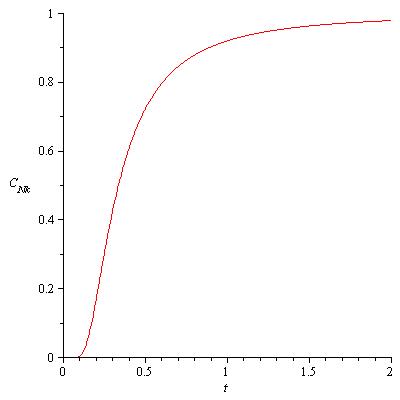
 . However, when
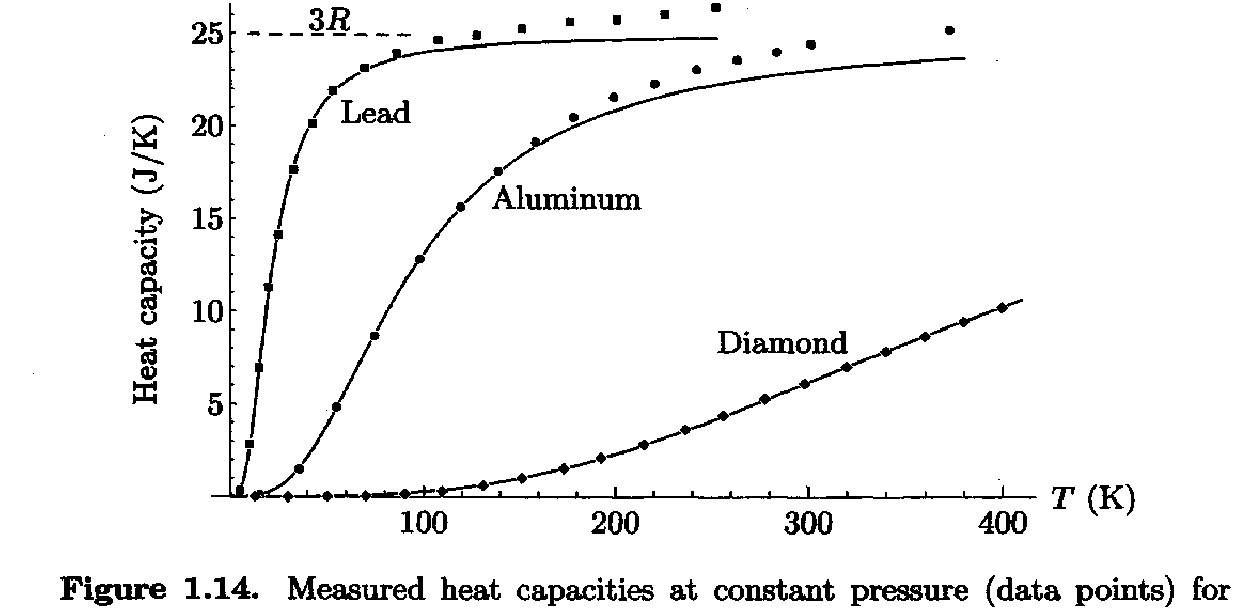
  , there appears to be a dramatic increase in the heat capacity in the dimensionless quantity
  . If the heat capacity
  is graphed as a function of temperature
  values for each of the lead and aluminum curves produced in Fig. 1.14 of Schroeder’s An Introduction to Thermal Physics.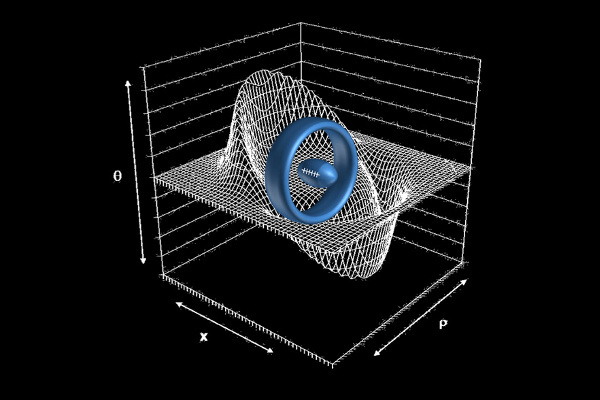
 is invariant with respect to Lorentz transformations. This is a pretty standard problem in most GR textbooks and in fact in some introductory books on SR.
 , there exists points whose difference relative to
  .
. -dimensional hypersphere whose surface area is given by
 is the gamma function given by

 and the orbital radius vector of Alpha Centauri B is
  . The masses of Alpha Centauri A and B are
  , and
, and  , respectively. The total mass of the binary orbit
  . Therefore, the derivation of the total energy of the binary system of Alpha Centauri A and B will be carried out in such a coordinate system.


 represents the separation distance between the two components. Let us take the derivative of Eqs.(0.1) and (0.2) to get


 in Eq.(0.3) we get the total energy of the binary Alpha Centauri A and B. This is true for any binary system assuming center-of-mass coordinates.
 …The model of a solid as a collection of identical oscillators with quantized energy units…”
 for each of those solids.”

 units, and let $N = 50$. The corresponding data table for this Einstein solid follows. The following set of equations were used to determine the multiplicity and entropy.

 is the multiplicity. The remaining quantities of temperature were obtained using a simplified form of the central difference equations for the first order derivative. The respective definitions of temperature and heat capacity are

 is the entropy. The generalized from of the first order central difference approximation has the form
 represents the higher order terms, in this case, the quadratic, cubic, quartic, and so on, and
  is the step size for each iteration. For the final iteration (when
  units of energy. The backward difference approximation has the form
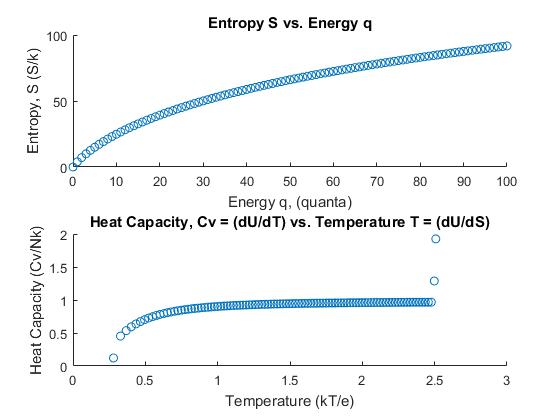
 . Using this in the calculation yields the following table for this Einstein solid. This “dilutes” the system and lowers the temperature:
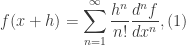
 :
:

 . Therefore, if we consider the following differences…




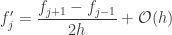
 represents the quadratic, cubic, quartic,quintic,etc. terms. One can use similar logic to derive the second-order finite-difference equations.

 :
:
 so as not to confuse it with the notation for an ordinary derivative. Recall the Navier-Stokes’ equation and the vorticity equation

 and let
  and
and  . Then,



 multiplied by a volume element
  given by
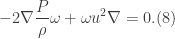
 , the total derivative becomes an ordinary time derivative. Thus, Eq.(10) becomes
![\displaystyle \int_{V_{\omega}}\frac{d}{dt}(\textbf{u}\cdot \omega)dV=\iint_{S_{\omega}}\bigg\{\nabla \cdot [-\frac{P}{\rho}\omega + \frac{u^{2}}{2}\omega ]\bigg\}\cdot d\textbf{S}=0. (11)](https://s0.wp.com/latex.php?latex=%5Cdisplaystyle+%5Cint_%7BV_%7B%5Comega%7D%7D%5Cfrac%7Bd%7D%7Bdt%7D%28%5Ctextbf%7Bu%7D%5Ccdot+%5Comega%29dV%3D%5Ciint_%7BS_%7B%5Comega%7D%7D%5Cbigg%5C%7B%5Cnabla+%5Ccdot+%5B-%5Cfrac%7BP%7D%7B%5Crho%7D%5Comega+%2B+%5Cfrac%7Bu%5E%7B2%7D%7D%7B2%7D%5Comega+%5D%5Cbigg%5C%7D%5Ccdot+d%5Ctextbf%7BS%7D%3D0.+%2811%29&bg=ffffff&fg=333333&s=0&c=20201002)

 is the magnetic vector potential which is described by the following relations

 . From the theorem it is known that the flux of the associated magnetic field is linked with surface
 , the elements of plasma contained within



 Additionally, if we imagine a cylinder formed by projecting a circular cross-section from one surface to the other, we may consider its length to be
  with area given by the cross product:
  . Moreover, since we know that the area of integration is a closed region we see that the integral vanishes (goes to 0). Thus, we may write the difference





 Understanding Physics and Astronomy