Monte Carlo Simulations of Radiative Transfer: Overview

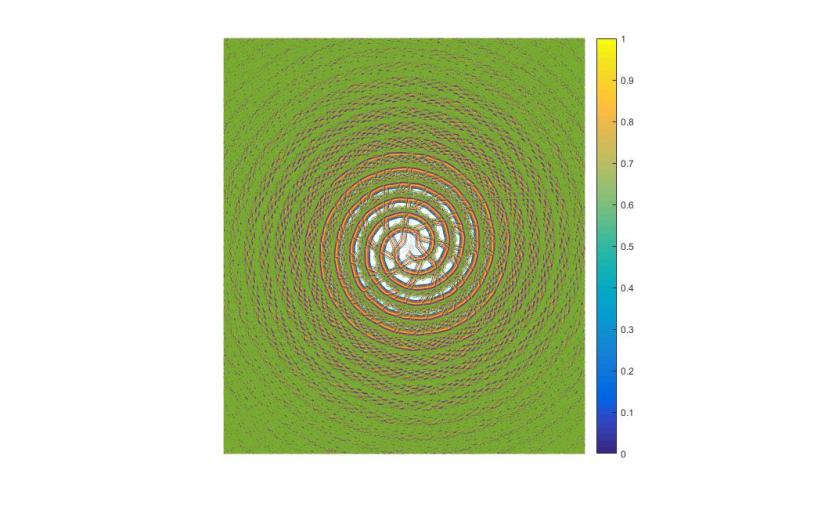
FEATURED IMAGE: This is one of the plots that I will be explaining in Post IV. This plot represents the radiation flux emanating from the primary and secondary components of the system considered. 

I realize I haven’t posted anything new recently. This is because I have been working on finishing the research project that I worked on during my final semester as an undergraduate.

However, I now intend to share the project on this blog. I will be starting a series of posts in which I will attempt to explain my project and the results I have obtained and open up a dialogue as to any improvements and/or questions that you may have.

Here is the basic overview of the series and projected content:

Post I: Project Overview:

In this first post, I will introduce the project. I will describe the goals of the project and, in particular, I will describe the nature of the system considered.   I will also give a list of references used and mention any and all acknowledgements.

Posts II & III: Radiative Transfer Theory

These posts will most likely be the bulk of the concepts used in the project. I will be defining the quantities used in the research, developing the radiative transfer equation, formulating the problems of radiative transfer, and using the more elementary methods to solving the radiative transfer equation.

Post IV: Monte Carlo Simulations

This post will largely be concerned with the mathematics and physics of Monte Carlo simulations both in the context of probability theory and Ising models. I will describe both and explain how it applies to Monte Carlo simulations of Radiative Transfer.

Post V: Results

I will discuss the results that the simulations produced and explain the data displayed in the posts. I will then discuss the conclusions that I have made and I will also explain the shortcomings of the methods used to produce the results I obtained. I will then open it up to questions or suggestions.
 

Basic Equations of Ideal One-Fluid Magnetohydrodynamics (Part III & IV)

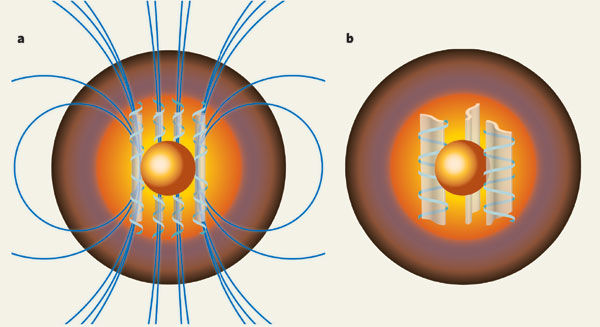
FEATURED IMAGE CREDIT: U.R. Christensen from the Nature article: “Earth Science: A Sheet-Metal Dynamo”

The image shows the overall distortion of magnetic field lines inside the core and its’ effect on the magnetic field outside. 

This post shall continue to derive the principal equations of ideal one-fluid magnetohydrodynamics. Here I shall derive the continuity equation and the vorticity equation. Furthermore, I shall show that the Boussinesq approximation results in a zero-valued divergence. I have consulted the following works while researching this topic:

Davidson, P.A., 2001. An Introduction to Magnetohydrodynamics. 3-4,6. 

Murphy, N., 2016. Ideal Magnetohydrodynamics. Lecture presentation. Harvard-Smithsonian Center for Astrophysics. 

Consider a fluid element through which fluid passes. The mass of this element can be represented as the volume integral of the material density \rho:

\displaystyle m=\iiint \rho dV. (1)

Take the first order time derivative of the mass, we arrive at

\displaystyle \dot{m}=\frac{d}{dt}\iiint\rho dV = \iiint \frac{\partial \rho}{\partial t}dV. (2).

We now make a slight notation change; let the triple integral be represented as

\displaystyle \dot{m} = \int_{V}\frac{\partial \rho}{\partial t}dV. (3)

Now, the mass flux through a surface element dV = \hat{n}dV is \rho \textbf{v} \cdot dV. Thus, the integral of the mass flux is
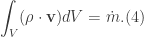
\displaystyle \int_{V}(\rho\cdot \textbf{v})dV = \dot{m}. (4)

We may write this as

-\displaystyle \oint_{\partial V}(\rho\cdot \textbf{v})dV= \int_{V}\frac{\partial \rho}{\partial t}dV. (5)

Now, we invoke Gauss’s theorem (also known as the Divergence Theorem) of the form

\displaystyle \int_{V}(\nabla \cdot \rho \textbf{v})dV=-\oint_{\partial V}(\rho \cdot \textbf{v})dV, (6)

we get

\displaystyle \int_{V}\bigg\{\frac{\partial \rho}{\partial t}+(\nabla \cdot \rho \textbf{v})\bigg\}dV=0. (7)

Since the integral cannot be zero, the integrand must be. Therefore, we get the continuity equation:

\displaystyle \frac{\partial \rho}{\partial t}+ (\nabla \cdot \rho \textbf{v})=0. (8)

Recall the following equation from a previous post (specifically Eq. (6) of that post)

\displaystyle \frac{\partial \textbf{v}}{\partial t}+(\nabla\cdot \textbf{v})\textbf{v}=-\frac{1}{\rho}\nabla\bigg\{P+\frac{B^{2}}{2\mu_{0}}\bigg\}+\frac{(\nabla\cdot \textbf{B})\textbf{B}}{\mu_{0}\rho}, (8)

Now we define the concept of vorticity. Conceptually, this refers to the rotation of the fluid within its velocity field. Mathematically, we define the vorticity \Omega to be the curl of the fluid velocity:

\Omega \equiv \nabla \times \textbf{v}. (9)

Now recall, the vector identity

\displaystyle \nabla \frac{\textbf{v}^{2}}{2}=(\nabla \cdot \textbf{v})\textbf{v}+\textbf{v}\times \Omega, (10.1)

which upon rearrangement is

(\nabla \cdot \textbf{v})\textbf{v}=\nabla \frac{\textbf{v}^{2}}{2}-\textbf{v}\times\Omega. (10.2)

Using Eq.(10.2) with Eq.(8) we get

\displaystyle \frac{\partial \textbf{v}}{\partial t}=\textbf{v} \times \Omega -\nabla \bigg\{\frac{P}{\rho}-\frac{\textbf{v}^{2}}{2} \bigg\}+\nu \nabla^{2} \textbf{v}. (11)

Recall our definition of vorticity. Upon taking the curl of Eq.(11) we arrive at a variation of the induction equation (see post)

\displaystyle \frac{\partial \Omega}{\partial t}=\nabla \times (\textbf{v} \times \Omega)+\nu \nabla^{2}\Omega. (12.1)

Next, we invoke another vector identity

\displaystyle \nabla \times (\textbf{v} \times \Omega) = (\Omega \cdot \nabla)\textbf{v}-(\textbf{v} \cdot \nabla)\Omega (12.2)

Using Eq. (12.2) in Eq. (12.1) yields the vorticity equation

\displaystyle \frac{\partial \Omega}{\partial t}+(\nabla \cdot \textbf{v})\Omega = (\nabla \cdot \Omega)\textbf{v}+\nu \nabla^{2}\Omega. (13)

Returning to the continuity equation:

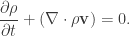
\displaystyle \frac{\partial \rho}{\partial t}+(\nabla \cdot \rho \textbf{v})=0.

I will now show that the flow does not diverge. In other words, there are no sources in the fluid velocity field. The Boussinesq approximation’s main assertion is that of isopycnal flow (i.e. flow of constant density). Therefore, let \rho = \rho_{0}>0. Substitution into the continuity equation yields the following

\displaystyle 0+ \rho_{0}(\nabla \cdot \textbf{v})=0. (14)

The temporal derivative is a derivative of a non-zero constant which is itself zero. This just leaves \rho_{0}(\nabla \cdot \textbf{v})=0. Now, since \rho_{0}\neq 0, this then means that

\displaystyle (\nabla \cdot \textbf{v})=0. (15)

Hence, the divergence of the fluid’s velocity field is zero.

Deriving the speed of light from Maxwell’s equations

We are all familiar with the concept of the speed of light. It is the speed beyond which no object may travel. Many seem to associate Einstein for the necessity of this universal constant, and while it is inherent to his theory of special and general theories of relativity, it was not necessarily something he discovered. It is, in fact, a consequence of the Maxwell equations from my first post. I will be deriving the speed of light quantity using the four field equations of electrodynamics, and I will explain how Einstein used this fact to challenge Newtonian relativity in his theory of special relativity (I am not as familiar with general relativity).  The reason for this post is just to demonstrate the origin of a well-known concept; the speed of light.

We start with Maxwell’s equations of electrodynamics

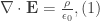
\nabla \cdot \textbf{E}=\frac{\rho}{\epsilon_{0}}, (1)

\nabla \cdot \textbf{B}=0, (2)

\nabla \times \textbf{E}=-\frac{\partial \textbf{B}}{\partial t}, (3)

\nabla \times \textbf{B}=\mu_{0}\textbf{j}+\mu_{0}\epsilon_{0}\frac{\partial \textbf{E}}{\partial t}. (4)

Now, we let \rho =0, which means that the charge density must be zero, and we also let the current density \textbf{j}=0. Moreover, note that the form of the wave equation as

\frac{\partial^{2} u}{\partial t^{2}}=\frac{1}{v^{2}}\nabla^{2}u. (5)

This equation describes the change in position of material in three dimensions (choose whichever coordinate system you like) propagating through some amount of time, with some velocity v.

After making these assumptions, we arrive at

\nabla \cdot \textbf{E}=0, (6)

\nabla \cdot \textbf{B}=0, (7)

\nabla \times \textbf{E}=-\frac{\partial \textbf{B}}{\partial t}, (8)

\nabla \times \textbf{B}=\mu_{0}\epsilon_{0}\frac{\partial \textbf{E}}{\partial t}. (9)

Also note the vector identity\nabla \times (\nabla \times \textbf{A})=\nabla(\nabla\cdot\textbf{A})-\nabla^{2}\textbf{A}. Now, take the curl of Eqs.(8) and (9), and we get

\frac{1}{\mu_{0}\epsilon_{0}}\nabla^{2}\textbf{E}=\frac{\partial^{2}\textbf{E}}{\partial t^{2}}, (10)

and

\frac{1}{\mu_{0}\epsilon_{0}}\nabla^{2}\textbf{B}=\frac{\partial^{2}\textbf{B}}{\partial t^{2}}, (11)

where we have used Eqs. (6), (7), (8), and (9) to simplify the expressions. Eqs. (10) and (11) are the electromagnetic wave equations. Note the form of these equations and how they compare to Eq. (5). They are identical, and upon inspection one can see that the velocity with which light travels is

\frac{1}{c^{2}}=\frac{1}{\mu_{0}\epsilon_{0}} \implies c=\sqrt[]{\mu_{0}\epsilon_{0}}, (12)

where \mu_{0} is the permeability of free space and \epsilon_{0} is the permittivity of free space.

Most waves on Earth require a medium to travel. Sound waves, for example are actually pressure waves that move by collisions of the individual molecules in the air.  For some time, light was thought to require a medium to travel. So it was proposed that since light can travel through the vacuum of space, there must exist a universal medium dubbed “the ether”. This “ether” was sought after most notably in the famous Michelson-Morley experiment, in which an interferometer was constructed to measure the Earth’s velocity through this medium. However, when they failed to find any evidence that the “ether” existed, the new way of thinking was that it didn’t exist. It turned out that light doesn’t need a medium to travel through space. Technically-speaking, space itself acts as the medium through which light travels.

 In Newtonian relativity, it was assumed that time and space were separate constructs and were regarded as absolute. In other words, it was the speed that changed. What this meant is that even as speeds became very large, space and time remained the same. What Einstein did was that he saw the consequence of Maxwell’s equations and regarded this speed as absolute, and allowed space and time (really spacetime) to vary. In Einstein’s theory of special relativity, as one approaches the speed of light, time slows down, and objects become contracted. These phenomena are known as time dilation and length contraction:

\delta t = \frac{\delta t_{0}}{\sqrt[]{1-v^{2}/c^{2}}}, (13)

\delta l = l_{0}\sqrt[]{1-v^{2}/c^{2}}. (14)

These phenomena will be discussed in more detail in a future post. Thus, Maxwell’s formulation of the electrodynamic field equations led Einstein to change the way we perceive the fundamental concepts of space and time.