While I was an undergraduate, one of my smaller research projects involved observing the variable star W Ursae Majoris.
In general, there are six types of binary star systems: Optical double, Visual binary, Astrometric binary, Eclipsing binary, Spectrum binary, and Spectroscopic binary.
In this project, my classmate and I were interested in the eclipsing binary (EW) W Ursae Majoris. An eclipsing binary is a binary system in which one of the stars will pass in front of its companion, effectively causing an eclipse. We are able to observe this by way of generating the light curves of the system. An example light curve is shown below:

(Image was obtained at the URL: https://imagine.gsfc.nasa.gov/educators/hera_college/binary-model.html)
The graph shows a plot of intensity over time (which in this case is an orbital period). Observations of an EW should show dips in the intensity of the two stars. What is really fascinating to me is that we can gain valuable information from this graph. For example, the length of a dip can indicate the masses of the star. If we have a star of mass  and the other is
  such that
  , and if the duration of the decrease in intensity of the system is significant we can then infer that the mass passing in front of its companion is that of . By default, the mass that is being “eclipsed” is . Conversely, if the intensity decreases but only for a short while, the positions are reversed, with passing in front (relatively speaking) and is being “eclipsed”. (I am assuming that the barycenter (i.e. the system’s center of mass) is equidistant from the centers of the two stars.)
Another form of classification of binary stars is whether or not the binary system components are touching or not. More precisely, there are three kinds of close binaries: detached, semi-detached, and contact binary. There are sub-categories of contact binaries: near contact, contact, overcontact, and double contact.
An equipotential surface map of a system (assuming that the binary system has a mass ratio of 2:1, which may be incorrect as most W UMa binaries have a mass ratio of 10:1) is shown below:

Image Credit: Fig.1 of Terrell, D., Eclipsing Binary Stars: Past, Present, and Future. JAAVSO Vol. 30, 2001.
To quickly elaborate, each type of contact binary will fill its inner Lagrangian surface (aka Roche lobes) to an extent. In the context of our project, W Ursae Majoris is an overcontact eclipsing binary system. This type of binary will overfill its inner Lagrangian surface. As a result of this, processes such as mass transfer and accretion can occur. The diagram below shows the orbital evolution of a W UMa EW AC Bootis (in addition to being its own binary system, W UMa is also a class of close binaries)

Image Credit: Fig. 15 of Alton, K., A Unified Roche-Model Light Curve Solution for the W UMa Binary AC Bootis. JAAVSO. Vol. 38, 2010.
The objective of the project was to image the eclipsing binary, measure the apparent magnitude, to process the images, and to obtain a light curve. To observe this system, a classmate and I made use of the 20″ Ritchey-Chrétien telescope at the university observatory. We made use of the CCD camera attached and set a sequence of images to be taken every two minutes. W UMa has a period of approximately 8 hours, however, due to time constraints (and as much as I would have liked to, the weather was not conducive for observations exceeding two hours), we ended up only taking images for around two hours.
After the session was over, we ended up taking a total of roughly 40-50 images. Additionally, the software used to capture the images simultaneously measured the magnitude of W UMa at the time each image was taken. This allowed us to use Excel (and later on MATLAB) to obtain a partial light curve. However, since this is a partial light curve, we can say that an eclipse (and a short one at that) occurs, yet we cannot determine whether or not the local minimum depicted in the graph below is a primary or a secondary minimum–we simply do not have enough data.
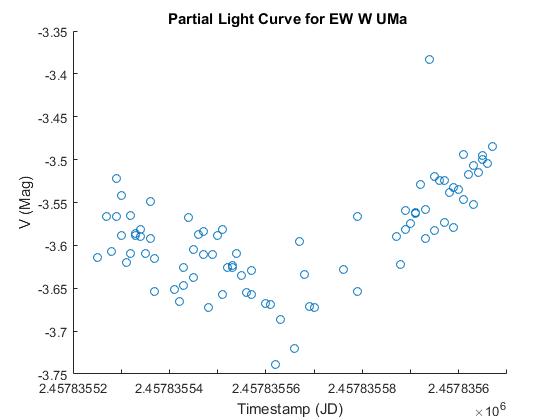
In addition to the partial light curve above, we were able to process the images (using Registax v.6). Below is a stacked image of W UMa. The big blob near the center of the image is the binary. The binary is not able to be resolved by telescopes component-wise.

References:
Caroll, B.W., and Ostlie, D. A., Introduction to Modern Astrophysics. 2017. Cambridge University Press. 7.
Catalog and Atlas of Eclipsing Binaries (CALEB): Types of Binary Stars
http://www.daviddarling.info/encyclopedia/C/close_binary.html
American Association of Variable Star Observers (AAVSO) URL: https://www.aavso.org/vsots_wuma
Journal of American Association of Variable Star Observers: Figure References










 Understanding Physics and Astronomy